|
Casting in Africa -
Useful Information
Africa is Big and Diverse
There are 1,250 to 2,100
different
languages spoken across the continent by almost as many ethnic groups.
At least 75 languages in Africa are spoken by populations of more a
million. The demographics and politics of Africa are complicated by the
fact that Colonialism resulted in national boundaries which
bear
no relation at all to ethnic, cultural, religious or language
demographics.
Although the majority of
Africans are Muslim or Christian, traditional religions survive and still play
a big role,
often in paradoxical combination with Christianity and Islam. Religious
practice in some form is an important part of daily life, with the
result that African society is essentially conservative.
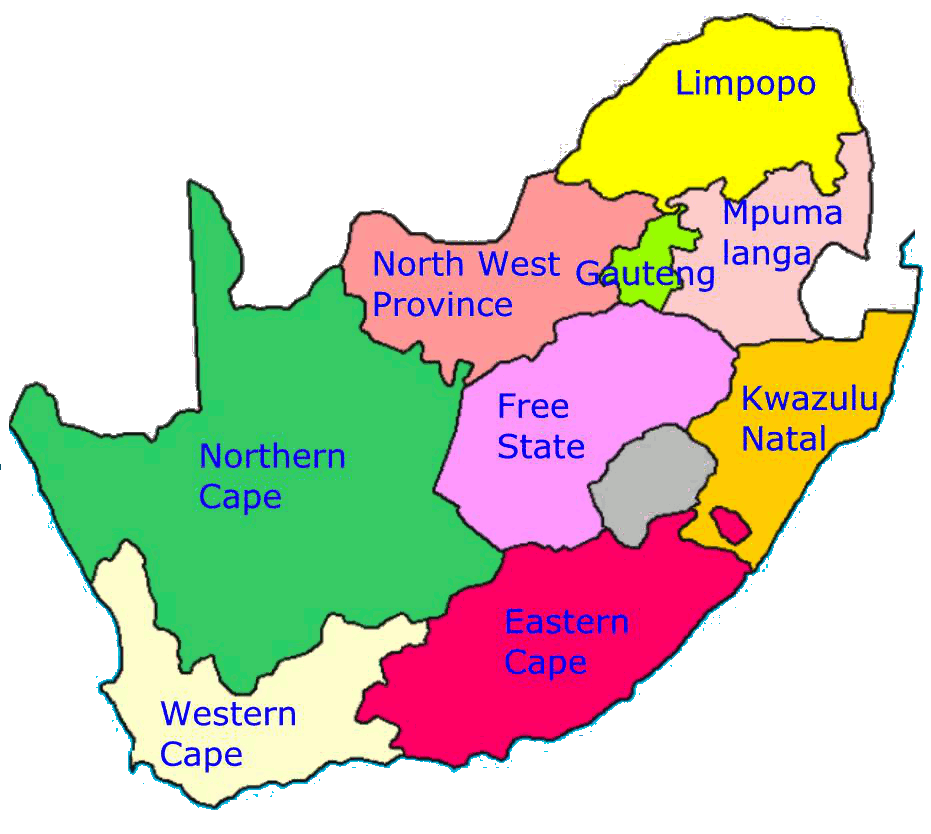
SOUTH AFRICA
Located
at the Southern tip of the continent, South Africa will feel like a big
country if you come from Europe. A flight between the two major Film
centres - Cape Town and Johannesburg - will take two hours and is the
equivalent of flying from London to Helsinki. On the other hand, the
country is about twice the size of the State of Texas. Within its
borders though, you will find a politically stable country with a
diversity of geography and ethnic appearance coupled with First World
infrastructure and favourable exchange rate that has made South Africa
a favoured film destination for over twenty years.
Ethnic
diversity :
I
have
been involved with casting for a wide variety of ethnic
groups.
For
"ALI" we needed French-speaking Zairians, for "I Dreamed of Africa"
Swahili-speaking
Kenyans and Somalians, for "Beyond Borders" we searched for
Tigrinia-speaking
Ethiopians. I have had to find people
who
looked
genuinely Chinese, Tibetan, Arabian, Egyptian and the full spectrum of
European looks from Scandinavian to Mediterranean.
The reality is that
whilst South Africans do encompass a wide variety
of
ethnic backgrounds, the pool of experienced, competent actors is fairly
limited. You may well find reasonable numbers of exotic ethnic groups
willing
to participate in your film, but you are being optimistic if you are
looking
to find "exotic" people capable of playing supporting roles. Let me
know
what leeway we have - could a South Afrian actor with Portuguese,
Italian
or Spanish ancestry acceptably play a Mexican in your particular
project?
Language:
The
South African Constitution recognises eleven official languages:
Afrikaans, English, Ndebele, Northern Sotho, Sotho, Swazi, Tsonga,
Tswana, Venda, Xhosa and Zulu. The most common language spoken as a
first language by South Africans is Zulu (23 %), followed by Xhosa
(16 %), and Afrikaans
(14 %).
English is the fourth most common first language in the country (9.6%),
but is understood in most urban areas. While Zulu, Xhosa, English and
Afrikaans are geographically
relatively
widely spoken, the other seven indigenous languages are fairly clearly
regional.
Most
South Africans can speak more than one language, with English
increasingly being the most common second language. Understand,
however, that English may well have been acquired as a
second
or third language, probably from a teacher who only speaks English as a
second or third language. Be patient. Also be humbled by the knowledge
that many of the people who are trying to communicate with you in
English
are able to speak as many as SEVEN other languages!
The Constitution also acknowledges "all
languages commonly used by communities in South Africa, including
German, Greek, Gujarati, Hindi, Portuguese, Tamil, Telegu and Urdu;
and Arabic, Hebrew, Sanskrit and other languages used for
religious purposes in South Africa."
French is spoken by a fairly small and dispersed community of migrants
from Francophone African countries.
Accent :
South
African English accents vary enormously from one end of the country to
the other as well as obviously from one social and economic group to
another.
If you have a particular accent requirement, please let me know well
beforehand.
Not all actors will be able to "turn on" an accent easily. A specific
requirement
may restrict your choices. If actors need to portray characters from
outside of South Africa, allow time
and budget for
dialogue
/ accent coaching! It is grossly unfair to
expect
an actor, however talented, who does not have access to LA training to
be able to acquire an accent unaided. I have access to a limited number
of very good English and American language Dialogue Coaches based here.
I could also arrange South African accent coaches, should your imported
actors require it....
Sources
of Talent :
There are two main
centres, at opposite ends of the country,
from which to source professional actors - Johannesburg and Cape Town,
with Durban as a much smaller additional source, particularly for a
limited
number of Indian / Asian actors.
Drama
training is available at Universities and Technikons and other smaller
facilities for example the Market Laboratory and the SA Schools of
Film,
TV & Dramatic Art in Johannesburg and Cape Town. Generally
speaking, emphasis
is
on theatre training and is of inconsistent standard.
Agencies
and Contacts :
Most
of the working professional actors are represented by about a dozen
major
talent agencies, the majority of whom are members of the Personal
Managers
Association. A number of Model Agencies also represent a wide
variety
of performers. There are also other informal Agencies who have access
to
a broad range of entertainers, dancers, musicians, singers etc.
A
useful
number of competent actors either work independently or move from one
agent
to another and are somewhat more difficult to contact. This is a
question
of keeping myself informed about current projects across the country,
including
so-called "industrial theatre", one man shows, festivals, cabaret etc.
Talent
Searches :
Moving
beyond the above sources in search of "raw talent" can be a
time-consuming
and expensive exercise. Reaching into outlying community theatre groups
for example, presupposes that you are clear about what you are hoping
to
find, have an understanding of the potential language and cultural
barriers
that you may encounter and can allocate a sensible amount of time and
budget
to any such talent searches. Given that at this level not everybody has
their own
telephone
/ fax or paid-up mobile, relaying a message via relatives or neighbours
can be a three-day process!
Minors
:
Common sense should
prevail when using
minors in order to
prevent
possible problems. South Africa has Film-Industry-specific Legislation for the protection of children. A Permit is required for each child employed. Among common-sense limitations on working hours according to the child's age.
It seems obvious that there should be a
dedicated
chaperone, an approved tutor who will liaise with the school,
sufficient
rest time on set and a sensible turn-around period. Drama, accent and
language
coaching should be available if necessary. Reliable transport
arrangements
and safety are priorities. There are a few specialist Agents who handle
children and teenagers, but generally, looking for talented youngsters
falls into the "talent search" category.
Visas:
Whether
for adults or minors, you are advised to check with your nearest South
African Legation and to allow plenty of time.
Academic year and the
Calander year :
Since
South Africa is in the southern hemisphere, the
Academic year closely follows the Calendar year, with the long summer
holiday coinciding with the Christmas holiday season. Since the most
productions film over the summer months in the Cape, this can present
difficulties in terms of availability of young people faced with end of
year exams or committed to family holiday trips.
Film
awareness :
It
is important to take into account that the culture of movie-going in
this
country is not extensive beyond the major cities. While it is possible
to meet talented performers who have never set foot in a conventional
cinema
and who have watched very little if any television drama, you cannot
assume
that there will be any conceptual understanding of working on film.
Audition
Process :
Detailed briefs including a
synopis and character descriptions are sent out by my office.
Sides are selected from the script and included in the brief. All
briefs and sides are submitted for producer approval before
distribution. Bearing in mind some of the language issues raised above,
it is advisable to send audition sides out as soon as possible. Cold
readings may well present the actor with difficulties that will not
fairly reflect their performance capabilities.
Auditions are
videotaped. Although "self taped" auditions are acceptable for
preliminary auditions, many actors still prefer to come into the
studio. Whenever possible we encourage actors to come to the studio for
Call Backs. Both studios are equipped with additional monitors
and high speed internet connections in order to facilitate zoom
auditions and call backs if the director cannot be present.
The Casting director's team processes all auditions, including "self tapes" and uploads them to the designated website.
Notifications with basic details about the artists are emailed to the distribution list approved by the Producers.
The
technical aspect of the studio is described in more detail under Studio
Facilities.
Acting
Styles :
Our
artists work on films made by people from all over the world, which
gives
them the advantage of being adaptable to various styles of performance.
However, remember that not all have had formal training, and all will
respond
to direction! If you find that a first reading is a little "broad" for
film... SAY SO. The reason may simply be that the actor has just done
either
a broad German TV comedy, a commercial stage farce, or a rumbustious
Community
Theatre educational play. A minute spent guiding the artist toward the
style or nuance you want will be rewarded.
Artists'
Contracts :
While some
progress has been made recently, we
do not yet have a SAG type standard contract, partly as a result of
working
with many different countries. The Facilitating Company could present
you
with a contract that is not acceptable to some Agents.
PLEASE arrive at a working draft contract as early as possible.
I will
send the relevant documents through to the Agents concerned and get
feedback
from them. Don't leave
this to the last minute! It is never advisable
to
allow an actor onto your set without a signed contract in your hands.
The Personal Managers Association, the South African Guild of Actors
and the Independent Film Producers' Organisation have recently made
good progress towards a generally accepted "Standard Terms
&
Conditions"
document which I recommend you consider as your basic contract. Changes and additions are
allowed for in a "Special
Conditions" section, Alternatively, you could use a separate
Addendum
in which you can make changes or add sections that are relevant to your
production.
South African Guild of
Actors :
Due
to a legal quirk - and insufficient numbers - it is impossible to form
an Actor's Union in South Africa. However, the South African Guild of
Actors was formed in 2009 and is affiliated to UASA, a moderate,
non-political Trade
Union with a history dating back to 1894. It may be true to say that
the majority of SAGA's work arises from issues with the national TV
broadcaster, but a SAGA task team has also engaged positively with
the Personal
Managers' Association and
the Independent Film Producers' Organisation to work towards an
equitable standard contract which is practical in the South African
context.
SAGA Web Site
Artists
Fees :
By
and large negotiable. Since there is no standardised Contract, there is
also no standardised breakdown of fees for features and television
drama.
As can be expected anywhere, you will pay according to experience and
ability.
Experienced local actors will surprise you with the range of their
work;
local stars may well be persuaded to work on a bona fide international
project in relatively small roles. However, you will be
expected
to pay a fee that is commensurate with their status and level of
experience
regardless of whether the role is substantial or not. Good actors will
certainly be interested in the script and in who they will be working
with.
A challenging script, a talented Director, a serious Lead and a fair
deal
will ensure that you will also have access to some of our top
talent.
Transport
Alert :
Our
Public Transport System is... different. Firstly, it isn't a System!
Thousands
of independent minibus taxi operators provide unscheduled commuter
transport
to the usual commuter-type destinations during normal business hours.
That
is of very little use to an actor or crew member needing to get to an
out
of the way Film Location at unsocial hours. Economic disparities mean
that
you cannot assume cast or crew have their own cars. Assistance with
transport
to and from Set should be discussed in advance and preferably included
in the Artist's Agreement.
Word Processing / Script Formats:
Microsoft Windows is
the most common
computer operating system in South Africa, although Apple's market
share within
the film industry has grown.
While Film production companies may have the very latest versions of
Microsoft
software, not everybody has fallen into the upgrade anxiety trap.
Talent
agents span both the socio-economic and technology spectrum, so "sides"
have
to be easily available for distribution by e-mail. Fax can be virtually
ignored as a means of communication.
Microsoft Word
is the word
processor
of choice, but not universally in the latest version. To help us make
your audition sides readily available to the widest range of talent,
please save
scripts in a format readable by Microsoft Word.
Adobe Acrobat
Reader is at least
freely
available, so the PDF
format
is
also accessible, although the files can be large and slow to distribute
via
e-mail.
While most Film companies have Final Draft or Final Draft
Reader,
passing on
scripts
to Talent Agents in this format is pointless. Extracting
"sides"
from Final Draft to
send to actors in a format they can use is cumbersome and
time consuming and
will therefore incur an extra charge. Final Draft is in any case able
to save
scripts in more accessible formats, so please also send us a
version of the
script as a PDF, or saved in
the cross-platform,
universally accessible
Rich
Text Format (*.RTF)
at least. The
loss of scene numbers and pagination is irrelevant to the casting
process since we extract "sides" as required. With a reference copy
in *.PDF we can regenerate scene numbers if required.
If
you
are a Producer or Director contemplating bringing your production to
Africa,
please send
an
e-mail outlining your requirements.
|
